Showing posts with label horror. Show all posts

Monday, August 19, 2013

11 GREAT HORROR STORIES


11 Great Horror Stories (1969) contains famous works from Lovecraft, Poe, and Stoker in addition to stories from a number of lesser-known authors, including Jack Finney, L. P. Hartley, Gerald Kersh, John Collier, A. E. Sendling, Anthony Vercoe, E. Everett Evans, and Fielden Hughes.

This collection is ambitiously but inaccurately named. While it may come as little surprise that not all the stories are great (most, in fact, are not), a goodly number of them aren’t even horror. There’s some straight fantasy here, and some historical fiction, and about the only thing these entries share with actual horror stories is some small measure of suspense.  

On the whole, the quality of the stories here is average. “The Oblong Box” is hardly Poe’s finest work, and all the horror stories are more or less by the numbers. The non-horror tales here, some of which are more ill-fitting than others, are of similar quality to these.  

The highlights of 11 Stories are Lovecraft’s “The Dunwich Horror” and Stoker’s “The Judge’s House” – you can easily find both of these classics in other, superior volumes, and there’s really not much else to get excited about.

TAKE IT OR LEAVE IT

Monday, October 10, 2011

THE MASK OF CTHULHU by August Derleth


The Mask of Cthulhu is a 1958 collection of six horror stories by August Derleth. These include “The Return of Hastur,” “The Whippoorwills in the Hills,” “Something in Wood,” “The Sandwin Compact,” “The House in the Valley,” and “The Seal of R’lyeh.”

All six stories are part of the Cthulhu Mythos originated by H. P. Lovecraft – “The Return of Hastur” is based on Lovecraft’s notes. Derleth says in the introduction to this book that these stories are a tribute to Lovecraft, and that they came about from Lovecraft urging his friends to expand the mythos.

Derleth is no Lovecraft. The elements that made Lovecraft’s stories so effective – atmosphere, tone, mystery – Derleth fails at. His stories are obvious, predictable, and melodramatic – Lovecraft’s lurking horrors don’t lurk here; you can’t go down to the basement without tripping over one. Compounding the problem, these stories have far too much in common with one another. If you’ve read one, you’ve pretty much read all six.

The Mask of Cthulhu might appeal to those enamored with the Cthulhu Mythos, but it just isn’t good horror.

NOT RECOMMENDED

Friday, September 24, 2010

AT THE MOUNTAINS OF MADNESS by H. P. Lovecraft


At the Mountains of Madness and Other Tales of Terror collects H. P. Lovecraft’s eponymous novella (originally published in 1936) and three short stories: “The Shunned House” (1937), “The Dreams in the Witch-House” (1933), and “The Statement of Randolph Carter” (1920).

In At the Mountains of Madness, an Antarctic survey team discovers the ruins of an ancient city, whose creators have conveniently left an easily-deciphered complete history of their civilization illustrated on the walls. This is one of Lovecraft’s later works, and in it, he substantially demythologizes his Cthulhu mythos, which previously had often featured a supernatural focus but here receives a rather thorough science fiction explanation.  

If you’ve read any quantity of Lovecraft before, you’ll find this novella fairly predictable. And if you’ve read a lot of Lovecraft, you realize you can’t go anywhere in his world without stumbling over some infestation of trans-worldly evil.

This is one of Lovecraft’s longer works, and it’s a bit of a slow builder, although it does pick up nicely as it goes. Lovecraft’s strength here is the usual one: atmosphere. Because of its isolation and severe environment, Antarctica lends itself particularly well to horror, and on top of that Lovecraft does a great job of depicting the atmosphere of the lost city.

The three short stories here have considerably more in common with one another than with Mountains, and they feel like padding to make this volume book-length (Additionally, this volume’s stupid cover has nothing to do with any of the stories within). But briefly, “The Shunned House” takes too long to get going and falls somewhat flat once it does, “The Dreams in the Witch-House,” something of a thematic bridge between the other two stories, is a disjointed mess, and “The Statement of Randolph Carter” is a vintage second-hand account of lurking horrors.

At the Mountains of Madness is hardly Lovecraft’s best story, but it may be some of the best atmosphere he’s ever done. I recommend the novella, whether you get it with extra mediocre stories or not.

RECOMMENDED

Monday, July 19, 2010

THE CALL OF CTHULHU by H. P. Lovecraft


The Call of Cthulhu and Other Weird Stories is a collection of H. P. Lovecraft works that includes sixteen short stories and the novellas “The Shadow over Innsmouth” and “The Whisperer in Darkness.”

Lovecraft is a master of atmospheric horror. Through suggestion, implication, and vague description (although his faithful “such-and-such” was too terrible to describe shtick gets old after a while), he allows the reader’s imagination to run with his lurking horrors. And yet his descriptions in every other aspect of his stories are so very detailed. This vividness allows him to ground his tales, making them more involving and therefore more moving. In all, Lovecraft is one of the best authors I’ve read when it comes to generating genuine terror.

Lovecraft’s repetition of style and theme begins to wear on the reader toward the end of this volume, but not as badly as in other collections. Structurally, many of the stories are very similar, and it doesn’t help that everything here but “The Haunter of the Dark” is told in the first person. Lovecraft wasn’t a one-trick pony, but he is best consumed in small doses.

This book features notes by S. T. Joshi. These notes are, frankly, obnoxious, primarily because both the introductions to each story and the mid-story notes are filled with spoilers, for their own stories and for others. For a book that could very well serve as many people’s first exposure to Lovecraft, this is unforgivable. And many of the notes aren’t even worthwhile; Joshi spends a lot of time fussing about the trivial: origins of character names and factual errors Lovecraft has made and the fact that cheese is in the story because Lovecraft loved cheese. And he spends a lot of time pointing out and overanalyzing the most obvious topical and thematic parallels between stories (corrupted bloodlines in “Arthur Jermyn” and “The Shadow over Innsmouth,” for example).

This is a solid collection – there are too many highlights to name – and I enjoyed every story here except “The Haunter of the Dark,” which was too slow, vague and been-there-done-that. But while this collection contains many of Lovecraft’s best stories, it seems to have been arbitrarily assembled. There is no discernible unifying theme. These stories aren’t from any particular timeframe; they range from the second published story Lovecraft ever wrote (“Dagon”) to the very last (“Haunter”). Many are not remotely connected with the Cthulhu mythos.

All told, The Call of Cthulhu and Other Weird Stories is a fine collection of Lovecraft’s better works, if you can ignore Joshi’s obnoxious notes.

RECOMMENDED

Wednesday, June 16, 2010

HAUNT OF HORROR by Richard Corben


Haunt of Horror is a 2009 trade paperback collecting Haunt of Horror: Edgar Allen Poe #1-3 and Haunt of Horror: Lovecraft #1-3. Richard Corben, with some plot and script assistance from Richard Margopoulos, adapts and illustrates poems and short stories by Edgar Allen Poe and H. P. Lovecraft. This volume also includes the source material.

Haunt of Horror opens with a truly awful prose rendition of “The Raven.” Many of Poe’s other poems are retold here, and nearly as badly. The liberties taken with the original texts are always for the poorer, a fact which is made all the more clear by the presence of each original work following the “adapted” stories. “Spirits of the Dead” is one of the few Poe pieces that isn’t awful.

The Lovecraft pieces are better, if for no other reason than that Corben, a respected horror artist, has an opportunity to give image to some of Lovecraft’s vague monstrosities. On the whole, Corben does a fair job, although it certainly doesn’t help that the entire volume is marred by horrendous narration and dialogue.

Corben’s black and white artwork is one of Haunt of Horror’s few pluses. He clearly has some stylistic range (although a few of his cartoonier pieces are questionable choices), and he does a fine job with light and shadow, allowing him to set tone and mood appropriately in spite of the literary travesty taking place all around.

Turning the works of Poe and Lovecraft into little more than tired EC Comics-style poetic justice gory schlock shorts does the original authors a great disservice. Fans of intelligent horror should look elsewhere.

NOT RECOMMENDED

Tuesday, June 15, 2010

THE DOOM THAT CAME TO SARNATH by H. P. Lovecraft


The Doom that Came to Sarnath and Other Stories is a collection of short stories written by H. P. Lovecraft between 1917 and 1935. Most of this is his earlier work; much of it is from his Dunsanian period, and none of these stories is part of the Cthulhu mythos.

This kind of atmospheric horror is tricky to write: if it’s too vague, it’s not compelling; if it’s too detailed, it ceases to be “weird” and easily becomes silly. Lovecraft always keeps safely to the vague side of the line (occasionally to the point that a story will fail to be interesting); flashes and hints of the supernatural keep the horror of mystery intact.

Yet even as he only hints at the attributes of his many lurking horrors, Lovecraft vividly describes every other element in his tales. He frequently name-checks fictitious places and things to add verisimilitude to his stories. And he loves nothing so much as the adjective; indeed, one is hard-pressed to find many unadorned nouns in his writing. But where else can one find sentences like, “It was in mid-summer, when the alchemy of nature transmutes the sylvan landscape to one vivid and almost homogeneous mass of green; when the senses are well-nigh intoxicated with the surging seas of moist verdure and the subtly indefinable odors of the soil and the vegetation” (“The Tomb”)? This is Lovecraft. Every sentence is like that.

Thanks to this and other talents, Lovecraft excels at creating atmosphere, which is so key to good horror. There is something appealing about the ancient – lost, alien, mysterious, eldritch things, and Lovecraft’s enthusiasm for them is evident in his writing.

Many of the stories here are dream-fantasies that are heavily influenced by the writings of Lord Dunsany. The trouble here is that after a couple such stories, the reader may realize that they’re all much the same, and one can readily see where most of them are going well in advance. “The narrator has vague interactions in malevolent dimensions resulting in madness and/or doom” (Lovecraft loves madness and doom) could be a plot synopsis for at least half the stories in this volume. His later, proto-Cthulhu tales are more interesting, and “In the Walls of Eryx” (Lovecraft’s only piece of science fiction), co-authored with Kenneth Sterling, is the best story here.

The Doom that Came to Sarnath and Other Stories is, on the whole, a decent collection that is too often hampered by repetition of plot, theme and device.

TAKE IT OR LEAVE IT

Thursday, February 12, 2009

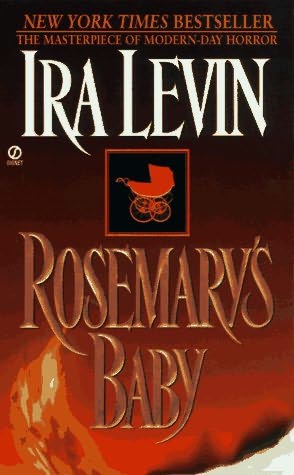
ROSEMARY’S BABY by Ira Levin


Rosemary’s Baby is a 1967 horror novel by Ira Levin. Rosemary, a young woman, moves into a New York City apartment with her husband, an actor. Immediately, they are befriended by a stiflingly attentive older couple. Rosemary becomes pregnant. Mysterious things begin to happen, and Rosemary starts to suspect that her neighbors are Satanists, and that they want her baby.

Rosemary’s Baby is a horror novel in name only. The way Levin writes it, the entire concept feels thoroughly silly. And the novel’s climactic scene, with a bunch of senior citizens standing around muttering “Hail Satan,” is inadvertently comical. Levin throws in a “twist” ending here that is neither particularly shocking nor interesting, and it doesn’t improve the story one way or another. In any event, the reader is more likely to get upset about the way Rosemary gets pushed around than about any demonic conspiracy.

For this and other reasons, Rosemary’s Baby is surprisingly unsuspenseful. Levin bludgeons the reader with such a smorgasbord of clues that anyone paying attention knows exactly where things are going (except perhaps for Levin’s “twist” ending). And Rosemary herself is so slow or dull or oblivious or something that she doesn’t pick up on any of these clues for the majority of the novel. So for differing reasons, neither the reader nor the main character is in any kind of state of suspense for most of the book (with 30 pages remaining, the novel does pick up a tad). Readers have every right to expect better from Levin – some of his later works were considerably more suspenseful (his play Deathtrap being a good example).

One of the reasons this novel fails is because Levin does nothing to set the mood. Horror, as much as or perhaps more than any other genre, requires a great deal of atmosphere. It takes an immersive world to help the reader past the inherit ludicrousness of the horror premise. If your elderly neighbors strolled out in broad daylight, smiled, waved, and said “Hail Satan,” you would have a hard time taking them seriously.

Rosemary’s Baby is also tedious. The first half of it is rather slow, which is all right if the author is building atmosphere or foreshadowing events (there’s a big difference between ominous foreshadowing and X-marks-the-spot, neon-sign clues), but Rosemary mostly spends this time decorating the apartment, cooking dinner, and socializing. And ultimately, the reader may well wonder whether the book would have been considerably more interesting if Rosemary were paranoid, and the cult of Satanists only the product of her imagination.
Levin’s writing style is fine – it doesn’t stand out as particularly good or bad – but he has the annoying tendency to pluralize nonstandard words ending with “y” (like “Bloody Mary” and “by”) with apostrophes.

On the whole, Rosemary’s Baby is a clunking, clumsy novel filled with annoying characters. Don’t waste your time.

NOT RECOMMENDED

Thursday, May 29, 2008

BALTIMORE by Mike Mignola and Christopher Golden


Baltimore, or, The Steadfast Tin Soldier and the Vampire
is an illustrated gothic horror novel by Christopher Golden and Hellboy creator Mike Mignola. This is the tale of Captain Baltimore, who encounters a vampire in World War I, and of his three friends, who meet and share their own experiences of gothic horror while they wait for him.

Thusly this volume is, more or less, a bunch of smaller tales that are connected. Many of them draw heavily on folklore, which is vintage Mignola. And most of them are entertaining, although some are fairly predictable. None, however, is more predictable as the novel’s climax and ending, which also manages to be rather anticlimactic. On top of this, the characters are not particularly well developed.

While the story is lackluster at times, the authors have done an excellent job with the tone. The writing, while overwrought at times, captures the gothic horror atmosphere for nearly the entire novel.

Mignola does the illustrations here. They are stark, black and white pieces, often extreme close-ups of objects, that do much more to help set the mood of the novel in a general way than specifically depict any particular scene. So even if the art is somewhat underwhelming, it still works.

A work of gothic horror like this cannot help but address religion. In Baltimore, faith is weak, and Christianity seems particularly neutered. The authors have thrown religion by the wayside in favor of hack-and-slash encounters with the supernatural.

Baltimore, then, is a decent but unspectacular gothic horror novel. It should appeal to fans of that genre, as well as fans of the authors, but probably not beyond that.

RECOMMENDED

Tuesday, February 5, 2008

I AM LEGEND by Richard Matheson


I Am Legend is Richard Matheson's short novel about the only survivor of a plague that has made everyone else on earth into something like zombie vampires. It is a foundational novel in the post-apocalyptic genre of science fiction and horror, and has been made into a movie three times: The Last Man on Earth (1964), with Vincent Price, The Omega Man (1971), with Charlton Heston, and I Am Legend (2007), with Will Smith. Of these, The Last Man on Earth follows the novel most closely.

Matheson's style often seizes on the mundane details of the situation, at times without apparent value to the story, but the overall effect is suspenseful, in large part because Matheson takes the reader inside the main character Neville's mental imbalance. Throughout the book, Neville is not only in danger from the vampires, but also from himself.

The edition I read also contained ten Matheson short stories, ranging in genre from horror to suspense. None of them are as good as I Am Legend, but a few of them are genuinely creepy and others show Matheson's knack for exploring the disturbed minds of his characters. The reader will also notice a few of Matheson's writing preferences (he loves to use the word "funereal", and he frequently describes characters' mouths as "gashes").

Like or not, books like I Am Legend are responsible for the now over-played zombie genre. Here, at least, it's done originally, and done well.

RECOMMENDED

Wednesday, January 30, 2008

ALFRED HITCHCOCK PRESENTS STORIES MY MOTHER NEVER TOLD ME


Stories My Mother Never Told Me is another in the series of short story collections Dell released in the sixties and seventies. Again, Alfred Hitchcock was not involved. This collection is primarily comprised of stories with either "shock" endings or fantastical elements.

There are thirteen stories here, by quite an impressive list of authors: F. Scott Fitzgerald, Shirley Jackson, Grace Amundson, Robert Arthur, Andrew Benedict, John Collier, Gerald Kersh, George Hitchcock, George Mandel, Richard Matheson, Jane Rice, Don Stanford, and Richard Wormser.

Unfortunately, not many of these stories are very spectacular. Several stories are interesting but lack punch at the end. Collier’s "Witch’s Money" I didn’t see the point of at all. There are too many cannibal stories (you’d think one per volume would be sufficient). And there’s an inferior take on Connell’s classic, "The Most Dangerous Game".

On the whole, there’s enough to keep fans of this type of thing entertained, but nothing particularly amazing.

RECOMMENDED

Friday, January 18, 2008

ALFRED HITCHCOCK’S THE BEST OF FIENDS


Alfred Hitchcock’s The Best of Fiends is part of a series of short story collections released in the sixties and seventies. Alfred Hitchcock, as I understand it, was not even peripherally involved with these books (his introductions were ghost-written).

Best of Fiends contains fourteen crime and suspense short stories by these authors: H. A. DeRosso, C. B. Gilford, Rog Phillips, Edwin P. Hicks, Richard Deming, Dick Ellis, Fletcher Flora, Neil M. Clark, Gilbert Ralston, Mary Linn Roby, Ed Lacy, Robert Colby, Jack Ritchie, and Richard O. Lewis.

Some of these stories seem amateurish and a few are predictable, but two are three are quite good and all of them are entertaining to some degree. On the whole, this is one of the weaker entries in the series, but nevertheless is a quick and diverting read.

RECOMMENDED