Showing posts with label history. Show all posts

Monday, January 27, 2014

LOU SCHEIMER: CREATING THE FILMATION GENERATION


Lou Scheimer: Creating the Filmation Generation is Scheimer’s 2012 autobiography, which he wrote with Andy Mangels. Scheimer co-founded Filmation in 1962, and he was the only one left when the sale to L’Oreal shut the company down in 1989. As such, this book also serves as a comprehensive history of Filmation, which is best known for such cartoons as He-Man and the Masters of the Universe, Fat Albert and the Cosby Kids, and Star Trek: The Animated Series.

The book begins with Scheimer’s parents’ immigration to the United States and his childhood and schooling; from the foundation of Filmation onward, Scheimer keeps things mostly chronological but largely gives a show-by-show account of events. I only have one real complaint about the way the book is laid out—it would have been nice to get more information on the animation process earlier in the book so that certain portions would be easier to follow.

The book has a very conversational tone, which makes it extremely engaging. Scheimer’s personality really comes through unfiltered, and by all accounts, he was quite a character. He never met a tangent he didn’t like, but most of what he has to say is so interesting that it’s easily forgiven (e.g., his dad purportedly punched Hitler in the face).

Scheimer heavily emphasizes his passion and vision for animation throughout the book. He was a trailblazer, he says, for incorporating racial diversity into children’s cartoons, and for producing material that communicated values, morals, and instruction. He was also committed to keeping animation jobs in the United States when most studios were sending large amounts of work overseas (this is, in fact, one of the primary reasons for Filmation’s well-known and oft-maligned stock animation system.

This is a huge book—8.5” by 11”, and almost 300 pages—and it’s kind of unwieldy. It’s worth wrestling with, though, because of the vast number of pictures. Contrary to what its Amazon page would lead you to believe, however, the book is not in full color. Only pp. 209–224 are; the rest are in black and white, so caveat emptor. The book really could have done with some serious copyediting, especially to clean up Scheimer’s serial misuse of “I” when he should have used “me” and the redundancies in the writing (Mangels, isn’t that your job?).

For me, at least, the production and editorial knocks on the book are readily forgivable. Lou Scheimer: Creating the Filmation Generation gave me a new appreciation for Scheimer, for Filmation, and for some of the cartoons I grew up with; I’m grateful simply that the book exists.

If any of the Filmation shows you grew up with are still meaningful to you as an adult, odds are you’ll find Lou Scheimer: Creating the Filmation Generation well worth your time.

HIGHLY RECOMMENDED

Monday, May 13, 2013

7 MEN by Eric Metaxas


7 Men and the Secret of Their Greatness is a 2013 book by Eric Metaxas. Here, Metaxas presents mini-biographies of George Washington, William Wilberforce, Eric Liddell, Dietrich Bonhoeffer, Jackie Robinson, Pope John Paul II, and Charles Colson.

Metaxas states in his introduction that he wants to answer the questions of what a man is and what makes a man great. The titular secret is that these men lived by faith, that they were surrendered to a higher purpose. Beyond the introduction, though, Metaxas never really bothers to tie things together, and as such, 7 Men is too underdeveloped in this area to serve as a thematic study.

Metaxas’s biographies are, by necessity, oversimplified snapshots (each is about twenty-five pages). As such, Metaxas gets to pick and choose what he includes, and he does a fair amount of handholding to make the points he wants to make to the reader, who may well feel written down to at times.

Metaxas’s accounts are heavy with editorial – and not without inconsistency. Jackie Robinson, for example, is lauded for turning the other cheek and blessing those who cursed (John Paul II is also praised here for his peacemongering ways); his chapter immediately follows the one on Bonhoeffer, who Metaxas praises for many things, one of which, specifically, is his attempts to murder Hitler (in fairness, this aspect of Bonhoeffer is an issue that many people either struggle with or punt entirely). Regardless of one’s position on Bonhoeffer’s actions, though, given Metaxas’s theme, it’s a jarring incongruity unaddressed.

Historical buffs will be dismayed to note that Metaxas primarily uses secondary sources and, in several cases, Wikipedia (the Washington-was-a-deist crowd will really have a field day). In the end, 7 Men may have the most merit as an introduction to these men, and in that respect, it is worthwhile, but from whatever angle you come at it, 7 Men virtually demands further reading from other sources.

In short, while these seven lives are extremely impressive, Metaxas’s accounts are somewhat less so.

TAKE IT OR LEAVE IT


*  *  *  *  *

Disclosure of Material Connection: I received this book free from the publisher through the BookSneeze.com book review bloggers program. I was not required to write a positive review. The opinions I have expressed are my own. I am disclosing this in accordance with the Federal Trade Commission’s 16 CFR, Part 255: “Guides Concerning the Use of Endorsements and Testimonials in Advertising.”

Sunday, November 16, 2008

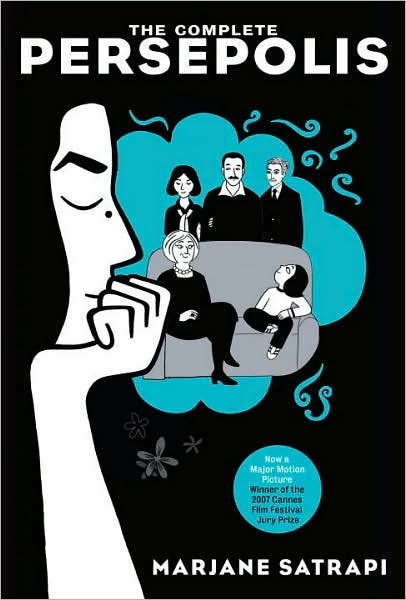
PERSEPOLIS by Marjane Satrapi


Persepolis, originally published in two volumes, is an autobiographical graphic novel by Iranian expatriate Marjane Satrapi. It chronicles her childhood in Iran during the Islamic Revolution, her coming of age in Austria, her return to Iran and her second departure, to France, after her failed marriage.

Satrapi’s black and white art is thick-lined, simple and spare, and it fits the book well. The vignettes of everyday life she presents are fascinating, because of Western unfamiliarity and because of her tremendous openness and honesty.

Ultimately, Persepolis is an engaging, many-layered work that gives an honest, revealing view of a way of life that most Westerners are extremely unfamiliar with.

HIGHLY RECOMMENDED

Tuesday, September 16, 2008

THE CRUSADES by Anthony West


The Crusades, written by Anthony West and illustrated by Carl Rose, provides a brief overview of the First through Fourth Crusades. This volume is just under 200 pages, which barely enough space for West to cover the who, what, why, where and when of things (most everything but the "what" is often glossed over).

West focuses on the people he sees as the key figures of each Crusade: Peter the Hermit, Saladin, Richard I, and Louis IX. Most other people are mentioned by name and title only, and without background they tend to run together. 

West does a good job of presenting the Crusades fairly, as there isn't room for much editorializing (all there is one egregious instance where West describes those crusaders who fled a hopeless, lost battle resulting from ambush as "cowards). He depicts the disorganization, incompetence, squabbling, and terrible acts of the crusaders, and some of the nobility and mercy of the Saracens. 

It is important to note that while the Crusades are often described as Christians versus Saracens, "Christians" is used in a cultural-political rather than spiritual sense. Certainly in hindsight the Crusades were a black eye for Christianity, and they involved large numbers of ignorant and hateful "Christians". The Crusades, by and large, couldn't have less to do with true Christianity. But nobody wants to re-label it along the lines of Europeans versus Saracens, because the objectives were religious in nature. 

Taking West's The Crusades for what it is, an introduction to the first four crusades, it is certainly not without value. 

RECOMMENDED

Thursday, August 7, 2008

HUMAN SMOKE by Nicholson Baker


Human Smoke: The Beginnings of World War II, the End of Civilization is Nicholson Baker’s history of the lead-up to World War II and the United States’ involvement in it. Rather than provide a continuous, blow-by-blow account of things, Baker uses hundreds of brief news items, averaging perhaps half a page in length. These range from 1892 to the end of 1941 (the vast majority of the book deals with the thirties and forties). As Baker recounts a wide assortment of events, he has several questions in mind. As he states in the afterword (p. 473): “Was [World War II] a ‘good war’? Did waging it help anyone who needed help?” Ultimately, Baker challenges World War II as the exemplar of just war.

Baker’s prose is engaging. He quotes whenever possible, and doesn’t editorialize much. The brevity of his entries keeps the book moving at a fast pace. Baker draws heavily from newspapers, diaries, memoirs and public statements, and ties each news item to a specific date. This helps keep the material honest.

A lot of what Baker focuses on reveals another side of World War II, one many Americans aren’t familiar with. Baker works to show that World War II did quite a lot more harm than it did good. Nevertheless, he at no time sympathizes with the Nazis – he accurately portrays how terrible they could be. Baker explores the warmongering side of Roosevelt and Churchill as well as Hitler. There is a side of the U.S. and Britain that he is keen to show, and some of the things these nations did might amount to shocking revelations for many people. World War II was brought about, to a great degree, by that great confluence of warmongers:

-The United States sold arms to Germany and Japan in the 1930s.
-Franklin D. Roosevelt, along with a great many other Americans and citizens of the world, was blatantly anti-Semitic.
-Before the Holocaust, Germany spent years trying to ship the Jews out. Nobody, including the United States, would take them. While this does not mitigate the horrors the Nazis perpetrated, it is alarming that by and large the rest of the world didn’t care what happened to the Jews. Certainly this helped cultivate the environment for the Holocaust.
-The British blockaded continental Europe, and would not allow food shipments through, even food intended for starving citizens of occupied France. Herbert Hoover, the much-reviled, erstwhile president, fought tooth and nail for the food shipments.
-For years, Roosevelt taunted and provoked Japan, hoping to lure them into striking first, so that he could bring the United States into the war without reneging on his campaign promises to keep the country out of war.
-Bombing, a major war strategy for both sides, was notoriously imprecise. An unbelievably small percentage of bombs hit their intended targets. Additionally, both Germany and Britain deliberately, purposely and repeatedly bombed civilian targets.

Human Smoke is recommended to those with an interest in World War II, and to those who believe World War II was a just war, or that it was fought according to the criteria of just war by any nation.

HIGHLY RECOMMENDED

Wednesday, May 21, 2008

THE STORY OF THE SECOND WORLD WAR by Katharine Savage


The Story of the Second World War, originally published in 1957, is a history of World War II written for young adults. This book more or less covers the entire war – a dubious task for a 300-page work. Thusly we get what happened but not why or how it happened, which is fine for a book of this sort. Savage covers the material fairly well, even including the roles of other nations, like India and South Africa, whose involvement in World War II is not often discussed.

Savage editorializes well beyond her purview. She uses inflammatory, sensational adjectives irresponsibly. For Savage, the Allies are always brave, courageous and heroic, while members of the Axis are greedy, treacherous, and often lucky in their conquests. When the Allies win a battle, they win it “on sheer courage.” Savage oversimplifies everything, which not only leads to inaccuracies, but makes the world leaders caricatures of themselves. Savage makes Hitler and Mussolini look like such buffoons it’s hard to believe they could conquer their way out of a paper bag.

All this leads to some egregiously inconsistent moralizing from Savage. When an Allied soldier kills a Nazi or a Japanese soldier, that’s “heroism.” When an Axis soldier kills somebody, that’s “an atrocity.” Savage goes out of her way to demonize the Nazis for their treatment and killing of civilians, yet turns around and categorically excuses the willful bombing of civilian targets by the Allies. Not surprisingly, she is also pro-atomic bomb. The overall effect is that the book reads like propaganda.

No doubt The Story of the Second World War is, to some extent, a product of the time in which it was written. But it does not hold up at all to objective scrutiny. There are innumerable better books on World War II out there, for any audience. Savage isn’t doing history any favors.

NOT RECOMMENDED

Sunday, April 27, 2008

GENGHIS KHAN: EMPEROR OF ALL MEN by Harold Lamb


Genghis Khan: Emperor of All Men is Harold Lamb’s biography of the great Mongol conqueror. In the West, Genghis Khan doesn’t seem to get half the attention that European conquerors like Napoleon and Alexander the Great did, even though Khan’s accomplishments are much more impressive, both in the sheer area conquered as well as the duration of the empire.

Lamb does an excellent job painting Genghis Khan, the thirteenth century warlord, as a survivor, charismatic leader, and brilliant military strategist. The amount of land he took with the number of troops he had is virtually unbelievable. More impressive is that he left something of a dynasty: his sons and grandsons ruled after him without squabbling amongst themselves. Alexander the Great, by contrast, was scarcely in his grave before there was factional conflict.

Lamb’s style is a bit dated (the book was originally published in the 1920s). His writing is lacking in punctuation. Many sentence fragments. And he doesn’t always have a good flow to his narrative. He jumps around at times and doesn’t satisfactorily flesh out certain things. More context would have been nice, as would have more and earlier background on the Mongol religion. But this is a short work, and on the whole, it’s is a great introduction to a massive historical figure that is being forgotten by the West.

RECOMMENDED

Monday, April 21, 2008

HANNIBAL by Harold Lamb


Hannibal is Harold Lamb's biography of the Carthaginian general Hannibal Barca. Hannibal is an enigmatic figure. Most of what we know about him was recorded by his enemies, and Lamb has taken innumerable accounts into consideration.

This book chiefly covers the Second Punic War (218-201 B.C.). Hannibal crossed the Alps, a feat which became legend, and ran amok in Italy years, defeating all comers (and many Roman commanders tried and failed to defeat him). Lamb gives great attention to Hannibal versus Scipio Africanus. This book also covers Hannibal's return to Carthage and later exile to the Eastern Mediterranean.

Lamb's writing is dry at times, and Hannibal can seem like a textbook. But Lamb does a fantastic job of providing historical context, and he is excellent in his description of battles and strategy. He also does a solid job of showing the personalities of Hannibal and the various Roman commanders.

On the whole this is an excellent biography of Hannibal, an excellent history in general, and a good treatise on warfare of the day.

RECOMMENDED