Showing posts with label Dark Tower. Show all posts

Friday, April 18, 2008

THE DARK TOWER by Stephen King


The Dark Tower is the seventh and final novel in Stephen King’s eponymous series. This is the longest book in the series by far, and it needs to be, after a bunch of nothing happened in Song of Susannah. After something of a slow start, the book picks up nicely, with a pace and urgency this series hasn’t seen in quite a long time. For the first time in a long time, the Dark Tower is suspenseful.

The Dark Tower also marks the expected appearances of a cavalcade of characters from King’s other works, as King (as he has stated) tries to tie practically his entire writing career together under the Dark Tower umbrella, and in that respect he does a fairly good job.

But The Dark Tower is far from perfect. This book is over the top in many ways – gruesome deaths and dismemberments, disgusting eating habits described in detail, and so forth. The “climaxes” at the end of the book are rather anticlimactic, as the resolution of the fates of three villains (Flagg, Mordred, and the Crimson King) are varying degrees of underwhelming. Many inexplicable and convenient developments occur, including but not limited to the handy teleportation seemingly available whenever needed. Deus ex machina is through the roof. King at one point even references his own use of it – and no, Mr. King, you don’t “hide it well.”

For the first time in the series, King shifts into first person narration here and there, and it’s extremely jarring. He mostly uses it to comment on or excuse what’s happening in the story: “Okay, someone’s about to die, it’s really sad, get ready, no, I don’t really want them to die either, but it’s out of my control, see?” In his author’s note, he again refuses to take responsibility, saying the story goes where it wants to. This is true to an extent, but King has always run down the field with it.

Many readers were no doubt upset by the fates of many long-running characters. But the fate of a character always remains completely within the author’s purview. If King says that’s what happened to Character A, then that’s what happened, and that’s the breaks. How a character meets his or her fate (and how it is portrayed) has a lot more to do with whether the writer did a good job than whether or not the author killed such-and-such a character.

As King himself says of this series in his author’s note: “I know that not been entirely successful.” This is quite true. But it has been successful more often than not, but not down the stretch, and not always when it counted.

All in all, The Dark Tower marks the end of an uneven, long-winded but worthwhile series that does not in any way compare to the classic epics like Tolkien’s Lord of the Rings (which King the character compares the Dark Tower series to at one point).

RECOMMENDED

Saturday, April 12, 2008

SONG OF SUSANNAH by Stephen King


Song of Susannah is the sixth and penultimate novel in Stephen King’s Dark Tower series. This is the shortest book we’ve had in this series for quite a while. And, as the characters are split up into three groups, we get less than 200 pages for each. Since King likes to move things along at a rather glacial pace, not a whole lot happens here.

Picking up where Wolves of the Calla left off, the characters disperse back to different times and places in twentieth-century America. Here they all mostly wander around for a while until they get to convenient stopping points that will (one hopes) give the last book an exciting beginning. The “cliffhanger” here is anything but. Like the entire Susannah-is-pregnant story arc, it’s hardly compelling (and it’s grown rather tiresome).

In Wolves of the Calla, King inserted himself into the Dark Tower world. Now he shows up as a character. While the reader’s initial impression of this is likely something along the lines of “Wow, how stupid,” like most things in this novel, it doesn’t matter one way or the other to the story, really, although King tries to tie together his writing career, life, the universe and everything with it. The book ends with a crypto-biographical diary from King the character which is, again, not particularly compelling.

This makes two poor entries in a row into the Dark Tower series. Song of Susannah is practically nothing but setup for the last book. On its own, it wouldn’t be worth bothering with.

TAKE IT OR LEAVE IT

Wednesday, April 2, 2008

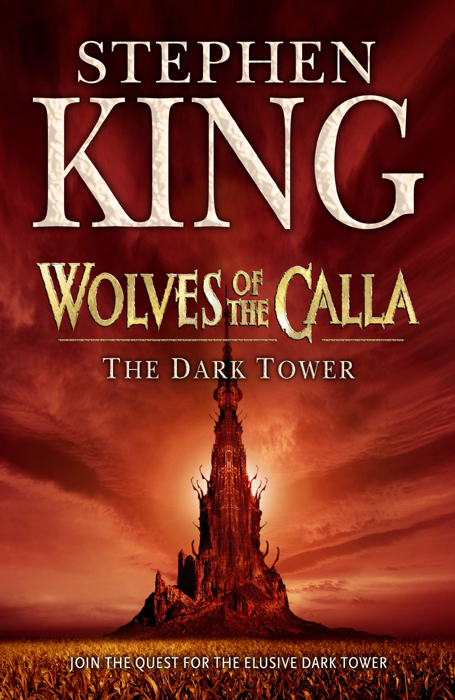
WOLVES OF THE CALLA by Stephen King


Wolves of the Calla is the fifth novel in Stephen King’s Dark Tower series. It is also the worst book in the series thus far. There are a ton of small plot holes here, and quite a few things that happen are pretty convenient. King tries to create suspense by hiding the main characters’ knowledge from the reader for hundreds of pages. But this is just tiresome and amateurish.

This book takes about five hundred pages to get going. It’s bogged down by a large amount of back-story and general farting around, much of this having to do with the homoerotic vagabond adventures of Father Callahan, who makes his first appearance since ‘Salem’s Lot, the second book King ever published. And Callahan is written inconsistently. He really doesn’t believe in God much, if at all, yet he staunchly holds to Catholic positions (seemingly for no other reason than the sake of the plot).

King continues his highly derivative, winking-at-the-reader “homages” to various other sources: this time it’s Star Wars, Harry Potter, Marvel Comics, and even King himself. When you combine these (Doctor Doom in the wilderness with the lightsaber and the exploding Harry Potter ball – it sounds like ridiculous Clue), the effect is exponentially worse.

If this were a stand-alone novel, there would be no compelling reason to read it. But those committed to reading the Dark Tower series through don’t have a choice.

TAKE IT OR LEAVE IT

Sunday, March 30, 2008

WIZARD AND GLASS by Stephen King


Wizard and Glass is the fourth novel in Stephen King’s Dark Tower series. It picks up precisely where The Waste Lands left off – with the riddling contest with Blaine the mono. This resolution is not completely satisfying, as it borrows noticeably from The Hobbit, down to specific riddles. But it gets the job done. The character then visit King’s own The Stand, then The Wizard of Oz. All of this feels somewhat derivative, and the reader gets the feeling that King is just making it up as he goes (which he likes to do).

The bulk of the novel, however, does not focus on these things. Rather, Roland tells a 500+ page story about his youth, a fantasy, post-apocalyptic western story full of teenage sex and hormones. There’s some attempt at mystery that doesn’t quite work, as there’s just too much sitting around, although the action scenes, when they come, are well done. We get more Cuthbert and Alain, and that’s a good thing. This story is interesting when it gets going, but it’s often slow-paced, and drags at times.

Wizard and Glass does little to advance the overall storyline. Instead, it gives the reader the formative experience of Roland’s life. And this is just fine.

RECOMMENDED

Tuesday, March 25, 2008

THE WASTE LANDS by Stephen King


The Waste Lands is the third novel in Stephen King’s Dark Tower series. It picks up several months after The Drawing of the Three, with Roland, Eddie and Susannah hiking through Stephen King’s imagination and a Richard Adams homage. Meanwhile, both Roland and Jake, who is back in New York, seem to be going crazy from the paradox Roland created in Drawing.

In the first three hundred pages of The Waste Lands, practically nothing happens. Jake rejoins Roland, and the reader is inundated with foreshadowing of the second half of the book, which seems to have little purpose and is boring. The second half of the book makes up for it, as the group navigates a post-apocalyptic city. Here, Roland tries to rescue Jake and the group tries to find and ride Blaine, the train previously foreshadowed ad nauseum. This latter half of the book is quite exciting, as King is at his best here. His characters are outstanding. And there’s a cliffhanger ending.

This is a very uneven book, but it certainly has its high points.

One complaint: A bear that “stood seventy feet high” would not have an eye socket “nearly the size of a baseball”. That eye is way disproportionately small.

RECOMMENDED